1. Like Quixote, it's obsessed with its own fictitiousness. When Oroonoko arrives in Suriname, he hears from Trefry about this beautiful, beautiful slave girl—and of course when Oroonoko meets her, she turns out to be Imoinda. He tells Trefry (who loves stories about love) their history—and, the narrator notes, "Trefry was infinitely pleased with this novel" (Oxford UP, ed. Salzman, 43). Salzman has a very note in the back: "novel: i.e. new thing, though perhaps with a reference to the nouvelle/novel as a literary form in the Restoration concerned with such narrative turns" (n. 43, 271); this hesitancy seems to me much more cautious than is necessary—Behn is highly interested in discussing truth and fiction, and is very much in control of her novel's dalliance with metafiction.
There are several discussions of how lying—the bad fictiveness—is a uniquely European thing: the Surinamese natives don't have the concept, and Oroonoko's people, when he's at home, consider lying extremely dishonorable. The Englishmen in the novel, on the other hand, are constantly affirming their truthfulness on Jesus' dead body and then doing shitty dishonest things. The narrator is very critical.
The narrator also acknowledges that her audience may not believe her about the wonders of the new world, and so she offers all sorts of details about the snakes and fish and eels and birds and monkeys in Surinam, and corroborates them by noting that she had a cape of one kind of feathers sent back to London to be used in a production of 'The Indian Queen.' (Another acknowledgment of the fantasy of this exotic place is when the narrator talks about the eel that makes the catcher weak and sick—she says that Englishmen won't believe there is such a thing so cold as it could do that.) But of course setting up the 'reality' of the place is constructed in terms of fiction—the evidence for the birds' reality is that their feathers were sewn into a cape to be used as a costume in a play about the New World. What may be real evidence of America is immediately conscripted into the props for its fictional representation. The narrator seems to want to make it real, but before it can be real, it necessarily becomes fake again. (It also becomes part of someone else's fiction—is put onstage not in an Aphra Behn play, but one by Dryden. Which at least is a nice way of representing how semi-truth is turned into explicit fiction—stories of America that began as sort of true get spun into bigger, wilder stories that are not about any real place at all, but just the imagination of them in listener's heads.)
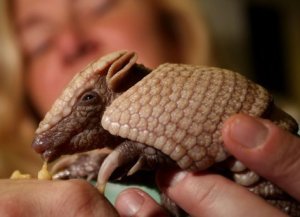
2. Oh yeah—at one point, she eats an armadillo. Very tender, apparently.

Baby armadillo - by Tom Uhlman/AP Photo
3. The novel loves cruelty. People and occasionally animals keep being killed with an arrow to the eye. There's a description of how the native young men bargain to be chiefs in battle by slicing off bits of their bodies —a nose, an arm—until they've proved they're braver than the other candidates. (As a result, almost all the men are too ugly to look at: the narrator initially takes them for monsters.)
But the novel is most horrified and pleased of all by its recounting of the ten pages it takes Oroonoko to die—first, he's beaten and his wounds rubbed with pepper for leading a slave rebellion, then he recovers a bit (his friends give him a bath, to wash off the pepper) and goes for a walk with Imoinda and cuts her head off, then he spends almost a week with her rotting flower-covered corpse in the woods, then finally he's captured and brought back, nursed a bit, and then killed. Before he's brought back, though, he
cut a piece of flesh from his own throat and threw it at 'em...At that he ripped up his own bely, and took his bowels and pulled 'em out with what strength he could, while some, on their knees imploring, besought him to hold his hand. But when they saw him tottering, they cried out, 'Will none venture on him?'... Tuscan...cried out, 'I love thee, O Caesar, and therefore will not let thee die if possible' and, running to him, took him in his arms, but, at the same time, warding a blow that Caesar made at his bosom, he received it quite through his arm, and Caesar, having not the strength to pluck the knife forth, though he attempted it, Tuscan neither pulled it out himself, nor suffered it to be pulled out, but came down with it sticking in his arm because the air should not get into the wound. (71)
The narrator doesn't want to see this—she's been taken away from the plantation for a few days, when Oroonoko is initially brought back, he smells so bad that she has to go away again: "(Being myself sickly," she says, "and very apt to fall into fits of dangerous illness upon any extraordinary melancholy), the servants and Trefry and the chirurgeons promised all to take what possible care they could of the life of Caesar, and I, taking boat, went with other company to Colonel Martin's, about three days' journey down the river" (71-2).
Because the narrator and Trefry are gone when Oroonoko is killed, his execution is probably narrated by her mother and sister. She's never mentioned them before this paragraph, but now they're on hand to give the last episode of the novel:
He had learned to take tobacco; and when he was assured he should die, he desired they would give him a pipe in his mouth, ready lighted; which they did. And the executioner came, and first cut off his members, and threw them into the fire; after that, with an ill-favored knife, they cut off his ears and his nose and burned them; he still smoked on, as if nothing had touched him; then they hacked off one of his arms, and still he bore up, and held his pipe; but at the cutting off the other arm, his head sunk, and his pipe dropped, and he gave up the ghost, without a groan or a reproach. My mother and sister were by him all the while, but not suffered to save him; so rude and wild were the rabble, and so inhuman were the justices who stood by to see the execution, who after paid dearly enough for their insolence. They cut Caesar in quarters, and sent them to several of the chief plantations: one quarter was sent to Colonel Martin, who refused it, and swore he had rather see the quarters of Banister, and the Governor himself, that those of Caesar, on his plantations; and that he could govern his negroes without terrifying and grieving them with frightful spectacles of a mangled king. (72-73)
There's one more paragraph—reminding us that Oroonoko was "worthy of a better fate," and that Imoinda was "brave, beautiful and constant," and that the novelist is a woman, and so can't celebrate them in the way she would like—and then it ends. WOW.